
Week 41: Misleading Swiss links - online shops with return addresses in Asia
It has a .ch domain, the name of a Swiss city in the URL, and a touching story about how it was founded in Switzerland. Everything points to a local, trustworthy business. However, upon closer inspection of the legal notice, terms and conditions or website source code, a different story is revealed: the company is based abroad, the images are AI-generated, and the warehouse is actually in Asia.
The NCSC receives numerous reports of fraudulent or highly dubious online shops every week. Recently, a number of these shops have stood out for using a particularly deceptive form of ‘Swiss washing’. They deliberately exploit people’s trust in Swiss online retailers to sell low-quality goods from Asia at inflated prices. In some cases, customers never receive their orders at all.
The scam: Swiss fiction, foreign reality
The shops look highly professional and often use a combination of a first name – usually a woman's – and a Swiss city in their web address. Together with a .ch domain and constant, steep discounts, this quickly gives the impression that you are shopping at a local boutique. Their ‘About us’ pages often feature a heart-warming but entirely fictional story about how the business was founded in Switzerland.
Another common tactic is to claim that the business is about to close down or is being liquidated, which supposedly explains the steep discounts. The reality, however, is very different. A closer look at the legal information on these shops' websites reveals the following:
- Either the legal notice is missing altogether, or it lists a person in Portugal, a shell company in England, or an address in the Netherlands.
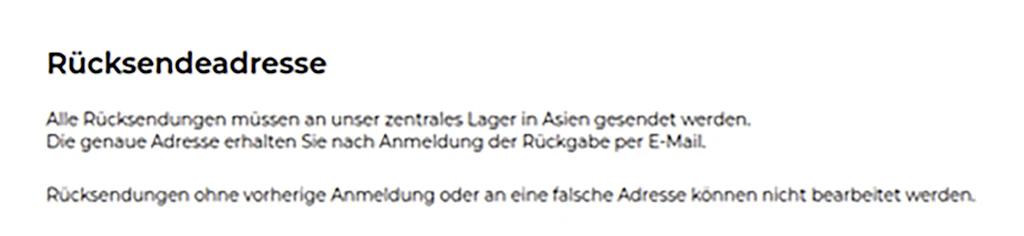
- The refund policy states that the main warehouse is located in Asia.
- To showcase extensive product ranges and professional-looking model photos with minimal effort, the operators use artificial intelligence. Often, they don't even bother to cover their tracks: a look at the website source code or the image URL reveals filenames such as ChatGPT_Image_[date].png.

The unpleasant surprise after placing an order
Customers tempted by the supposed discounts often have to wait weeks for their order. When the goods finally arrive, they have usually been shipped from Asia and often differ greatly from the glossy, AI-generated images in terms of quality, materials or size.
Trying to return the goods often leads nowhere. Because the terms and conditions state that returns must be sent to the main warehouse, customers suddenly find themselves facing very high postage costs to Asia. These return costs often far exceed the value of the goods, making a return or exchange financially pointless.
Why doesn't the NCSC simply block these websites?
The NCSC is often asked to block such .ch domains immediately. However, under the Ordinance on Internet Domains (OID), the NCSC can only request that Switch, the registry operator, block a domain if the website poses a technical threat, such as phishing for sensitive data or distributing malware.
Misleading claims about a shop's origin, concealed terms and conditions and dropshipping scams fall under the Federal Act on Unfair Competition (UCA) and criminal law. Responsibility for taking action against such practices lies with the law enforcement authorities and SECO. In these cases, the NCSC cannot request that the website in question be blocked.
Recommendations
To avoid falling victim to these kinds of online shops, the NCSC recommends carrying out the following checks before buying from an unfamiliar retailer:
- Do not rely on a .ch domain or a Swiss city name in the logo. Look for the legal notice. Who are you actually entering into a contract with, and where are they based? Check the refund policy to see where any returns would have to be sent.
- Do the product images look too perfect to be real? If you are browsing on a computer, right-click an image and select ‘Open image in new tab’ to check its web address. If you see terms such as "ChatGPT" or "DALL-E", exercise particular caution.
- Don't let countdown timers or unusually large discounts pressure you into making rash purchases..
- Search online for the shop name together with terms such as "reviews", "fraud" or "scam".
- Report the incident to the State Secretariat for Economic Affairs (SECO). If you have suffered financial loss, file a criminal complaint with the police and inform a consumer protection organisation such as the Consumer Protection Foundation (in German only).