
Awareness-raising campaigns
Raising awareness of cyberrisks amongst public authorities, businesses and the general public is part of the core remit of the National Cyber Security Centre (NCSC). This remit is based on the Information Security Act (ISG), the Cybersecurity Ordinance (CySO) and the objectives of the National Cyberstrategy (NCS). As part of this remit, the NCSC develops and runs awareness-raising campaigns to strengthen security awareness and promote the safe management of cyber risks.
The variety and differing demands of the target groups present challenges in this regard. In Switzerland, however, many stakeholders are already striving to make the use of computer-based devices and the internet safer and to contribute to cybersecurity. Accordingly, numerous projects are currently being implemented, and various initiatives are in the process of being established.
Since 2020, the NCSC has been working to coordinate the diverse requirements as well as planned and ongoing awareness-raising projects, and to support them as effectively as possible. The aim is to capitalise on synergies and reach as many users as possible with information on cybersecurity.
Campaign S-U-P-E-R.ch 2026: “SUPER, right?”
From 13 April to 10 May, the National Cyber Security Centre (NCSC), Swiss Crime Prevention (SCP), the cantonal and city police forces, Swiss Federal Railways (SBB), Swiss Post and the Swiss Insurance Association (SIA) are launching another edition of the national “S-U-P-E-R.ch” campaign under the slogan “SUPER, right?” to raise awareness of the importance of cybersecurity.
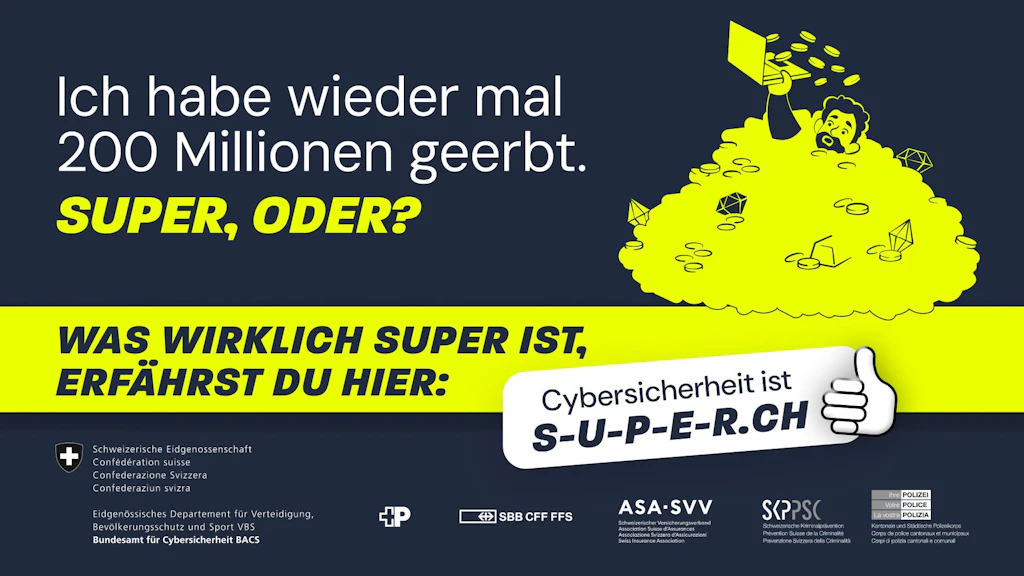
When a promise of easy money turns into an advance-fee scam
Wouldn’t it be nice to come into a large sum of money without any effort? This is the hope that criminals exploit in advance-fee scams promising fake inheritances. What begins as a surprising opportunity, however, does not end in a payout, but in a constant stream of demands for fees, taxes or supposed costs – all for a promised fortune that does not actually exist.
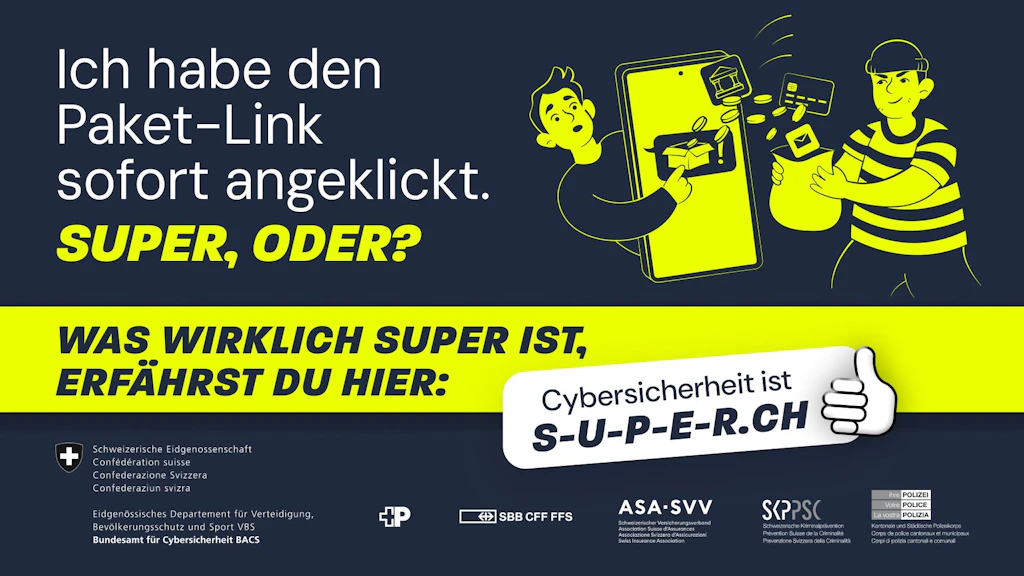
Parcel link fraud: When CHF 1.99 turns into an expensive trap
Although we often recognise and delete phishing or scam messages these days, parcel fraud is still successful. Parcel notifications seem believable because we all encounter delivery problems in everyday life, and all the message asks you to do is click on a link for further information. However, if you follow the link, you will end up on a fraudulent website that asks for your credit card details or tricks you into signing up for a subscription. Due to the growing use of delivery services, it is becoming more and more difficult to distinguish a genuine delivery issue from a fake one.
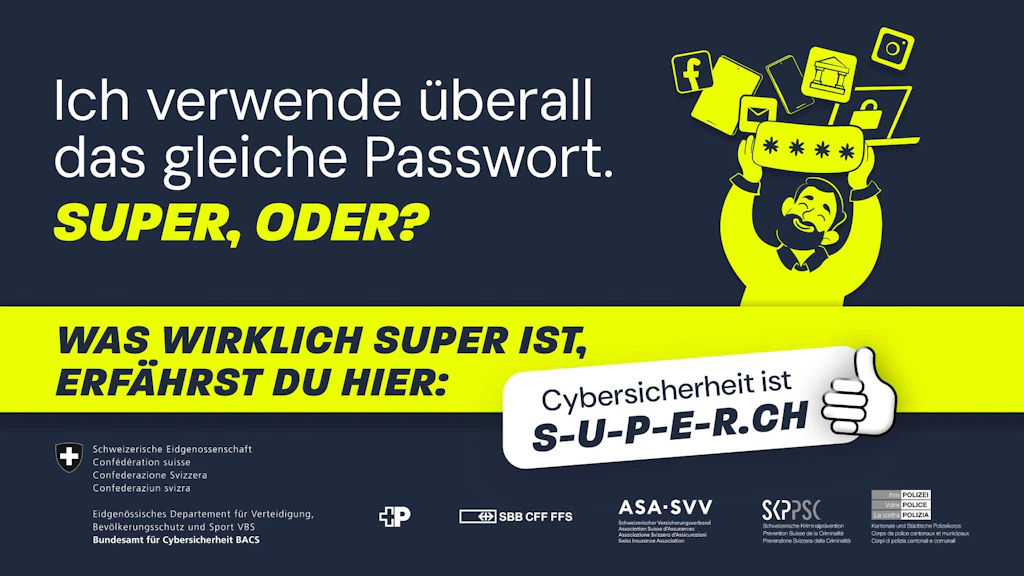
When one password puts multiple accounts at risk
Strong and complex passwords are key when it comes to protecting access to online services. However, they are often difficult to remember. For this precise reason, many people use the same password for several accounts or create passwords based on a recurring pattern. Both of these approaches significantly reduce security, and the danger of reusing passwords is often underestimated.
Online banking phishing: When a call from your "bank" is a trap
Almost every day, phishing or fraud attempts pop up in our inboxes or on our smartphones. Often, we recognise these criminal communications and delete them. However, when it comes to online banking in particular, a believably worded phone call, a seemingly official phone number or an SMS containing a verification code is frequently enough for fraudsters to gain access to sensitive data. Situations like these pose considerable risks. This year’s S-U-P-E-R.ch national awareness campaign, "SUPER, right?", reminds us that we should always check whether information is credible and stick to established cybersecurity strategies.
"SUPER, right?" – Launch of the 2026 national cybersecurity awareness campaign
Phishing and scam attempts are widespread, and many are identified early enough for people to take the necessary cybersecurity measures. But it is becoming increasingly difficult to tell fraudulent messages from genuine ones. Scammers are increasingly using AI to personalise their messages, making them appear more convincing than ever. This is precisely what the new cybersecurity awareness campaign highlights under the slogan "SUPER, right?". From 13 April to 10 May, the National Cyber Security Centre (NCSC), Swiss Crime Prevention (SCP), the cantonal and city police forces, Swiss Federal Railways (SBB), Swiss Post and the Swiss Insurance Association (SIA) are launching another edition of the national "S-U-P-E-R.ch" campaign to raise awareness of the importance of cybersecurity.
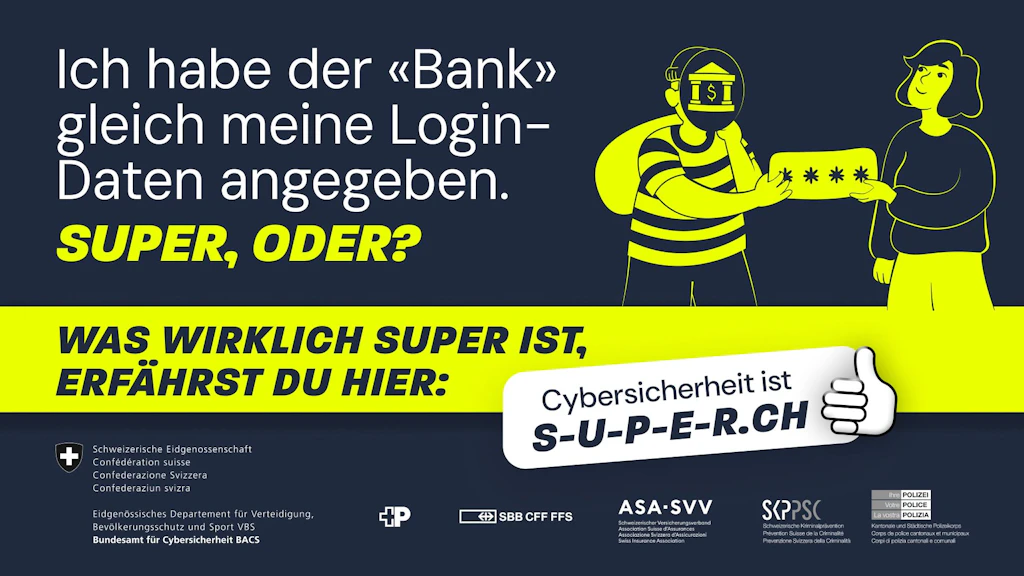

Cyber Security Month 2025: Together against phishing – how to protect your data
Phishing is and remains one of the biggest threats on the Internet. In October, the NCSC is organising an awareness campaign as part of the annual Cyber Security Month. This year's campaign focuses on the dangers of phishing and asks the question “How do I protect my data online?”.
Cyber Security Month: Tips for senior citizens
31.10.2025 - The internet is very useful, whether for banking transactions, shopping or keeping in touch with family and friends, but it does expose you to certain dangers. One of the biggest is ‘phishing’. Fraudsters try to persuade you to reveal personal data like passwords or account information using fake emails, text messages or messages. Older people are a particular target for these scams. In order to raise awareness among all users in a playful way, BACS has developed a word search puzzle on the topic of phishing.
Cyber Security Month: Tips for young people
20.10.2025 - Many young people spend a large part of their free time online. Whether chatting, on social media or gaming, the online world offers endless distractions. Since a large part of social life takes place on the internet and a lot of personal data is disclosed, the risk of being manipulated also increases. One of the biggest dangers is phishing.
Cyber Security Month: Tips for working people
02.10.2025 - Personal traces remain visible online for longer than intended. A thoughtless post, an open social media profile or an unsecured online account – all of these can have long-term consequences. Campaign ambassador Ivano Somaini will give an online lunchtime talk hosted by the NCSC on how to protect yourself and prevent personal data from falling into the wrong hands. Register today, places are limited.
Cyber Security Month 2025: Together against phishing – how to protect your data
24.09.2025 - Phishing is and remains one of the biggest threats on the Internet. In October, the NCSC is organising an awareness campaign as part of the annual Cyber Security Month. This year's campaign focuses on the dangers of phishing and asks the question "How do I protect my data online?". Much of the campaign content and a quiz were created in collaboration with the association Netpathie, working with young people. In a webinar, social engineer and campaign ambassador Ivano Somaini will demonstrate how cybercriminals use public or hacked data for attacks.
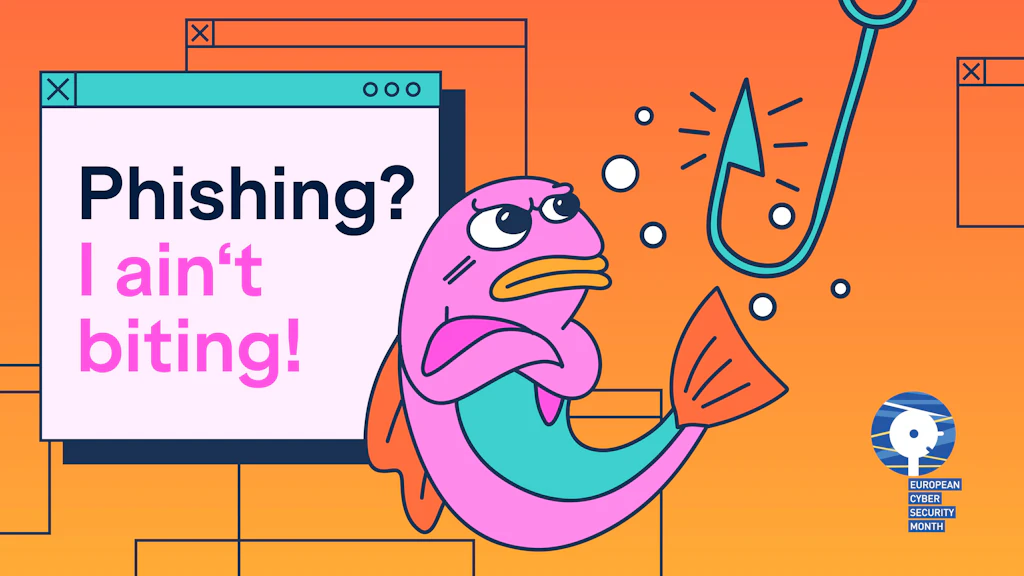
Campaign S-U-P-E-R.ch 2025: “No excuses – Do it!”
Ransomware – when nothing works
26.05.2025 - Suddenly everything is blocked: you can't access your systems and networks, all your data is encrypted – and shortly afterwards you get a ransom note. Typically, the note contains the threat that the data will be irrevocably deleted or published on the darknet. Unprepared companies are often faced with huge challenges at this point. But what can you do to prevent a ransomware attack or, if it is already too late, how can you deal with it in the best possible way? This year's national S-U-P-E-R.ch campaign "No excuses – take action!" calls on you to take responsibility and act preventively.
Classifieds websites: It pays to be careful – better to invest your time than to lose your money!
22.05.2025 - Online shopping and specifically classifieds have become part of everyday life. But where there are real bargains, scammers are often not far away: fake listings are an everyday danger on these websites. But how can you spot them and protect yourself so that you can safely use classifieds websites? This year's S-U-P-E-R.ch national awareness campaign reminds us that our own carelessness is often the greatest danger. By paying attention and staying informed, you can greatly reduce the risk.
Cybersecurity is a matter for the boss – why top management needs to get involved
15.05.2025 - Cybersecurity isn't just an IT problem; it is a strategic issue for the company's management. Organisations of all sizes are potential targets for cyberattacks, and the consequences can be devastating, ranging from financial loss and reputational damage to loss of customer confidence. If cybersecurity is seen only as an IT issue, it risks being overlooked as a priority. This is where the national awareness campaign S-U-P-E-R.ch comes in with its message No excuses – take action: cybersecurity starts as a strategic responsibility at the executive level and is then carried throughout the organisation.
Be careful when scanning: the hidden dangers of tampered QR codes
08.05.2025 - QR codes are now a common part of everyday life – used for paying bills, parking, or accessing restaurant menus. However, cybercriminals are exploiting this convenience by creating codes that lead to fraudulent websites or redirect payments to unauthorised recipients. The S-U-P-E-R.ch 2025 'No excuses – take action!' campaign highlights the importance of being vigilant when using QR codes and taking active steps to minimise the risks involved.
"No excuses – Do it!"- Launch of the 2025 national cybersecurity awareness campaign
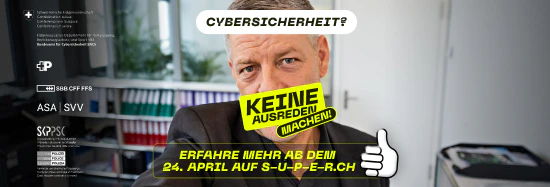
24.04.2025 - People often neglect to set secure passwords and install security updates. The National Cyber Security Centre (NCSC), the Swiss Crime Prevention Unit (SCP), cantonal and municipal police forces, Swiss Federal Railways (SBB), Swiss Post and the Swiss Insurance Association (SIA) are launching the next stage of the "S-U-P-E-R.ch" campaign to raise public awareness about cybersecurity under the slogan "No excuses – Do it!".


European Cyber Security Month (ECSM) 2024 - AI in cyberattacks
Artificial intelligence (AI) is increasingly being used in cyberattacks, particularly social engineering attacks. For this year's European Cyber Security Month (ECSM), the National Cyber Security Centre (NCSC) will be raising public awareness of this cyberthreat. The ECSM takes place every October and is organised by the European Union Agency for Cybersecurity (ENISA) together with the European member states.
European Cyber Security Month (ESCM): Tips for senior users:
24.10.2024 - Criminals have been scamming the elderly with distressing phone calls for some time. But now they are also using AI to carry out these attacks: they use voice cloning software that takes one or more voice samples of a person known to the victim and creates a fake voice that sounds similar. This allows scammers to pose as trustworthy people and deceive their unsuspecting victims. These scams are becoming increasingly difficult to detect.
European Cyber Security Month (ESCM): Tips for business users
10.10.2024 - Social engineering is successful because it exploits human needs and weaknesses. Studies show that social engineering plays a role in almost all cases of cybercrime. AI is also increasingly being used in these attacks. Audio deepfakes in particular are increasingly being used to attack businesses.
European Cyber Security Month (ESCM): Tips for young users
03.10.2024 - TikTok, Instagram, Snapchat and other similar apps offer many features that use artificial intelligence (AI), such as image generators, chatbots and tools that make AI-generated human faces. When an image or video is uploaded to the app, it is automatically analysed to suggest effects, filters or subtitles. These AI-driven background functions are not problematic in themselves, but their risks become apparent when they are used by criminals to manipulate their victims.
AI in cyberattacks – the NCSC's focus during European Cyber Security Month
30.09.2024 - Artificial intelligence (AI) is increasingly being used in cyberattacks, particularly social engineering attacks. For this year's European Cyber Security Month (ECSM), the National Cyber Security Centre (NCSC) will be raising public awareness of this cyberthreat. The ECSM takes place every October and is organised by the European Union Agency for Cybersecurity (ENISA) together with the European member states.

Campaign S-U-P-E-R.ch 2024 - Improve your digital health
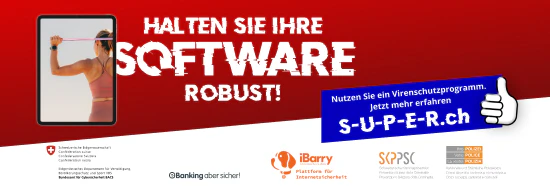
Regular updates and up-to-date virus protection greatly improve cybersecurity. This is why the National Cyber Security Centre (NCSC), Swiss Crime Prevention (SCP) and cantonal and communal police forces are now launching a further part of the national S-U-P-E-R.ch campaign emphasising the importance of up-dates and virus protection. The campaign is supported by the internet security platform iBarry and “eBanking – but secure!” (EBAS).
s-u-p-e-r.ch
S-U-P-E-R.ch – Beware of malware
25.04.2024 - Cybercriminals develop malware for a number of purposes: to disrupt or prevent the normal operation of a device, steal data or spy on the users' behaviour. Normally what is known as a 'downloader' is first sent to the device. It is not initially clear what damage this type of malware will cause.
S-U-P-E-R.ch - Keep your virus protection up to date
18.04.2024 - A virus scanner helps to ensure that your device is not infected by malware. It is one of the most important software components that protects your device and your data. The program scans new files, e.g. email attachments, and the entire device for signs of infection. It is important to install this software and keep it up to date.
S-U-P-E-R.ch – Carry out regular updates
11.04.2024 - A healthy lifestyle involves having a good diet and regular exercise. It's the same in the digital sphere: for your software to be kept fit, it must be updated regularly. This is the only way that the software can provide effective protection against unauthorised access to your device.
Improve your digital health – launch of national cybersecurity awareness campaign focusing on updates and virus protection
04.04.2024 - Regular updates and up-to-date virus protection greatly improve cybersecurity. This is why the National Cyber Security Centre (NCSC), Swiss Crime Prevention (SCP) and cantonal and communal police forces are now launching a further part of the national S-U-P-E-R.ch campaign emphasising the importance of up-dates and virus protection. The campaign is supported by the internet security platform iBarry and "eBanking – but secure!" (EBAS).



European Cyber Security Month (ECSM) 2023 - Social Engineering
The annual Europe-wide initiative is organised by the European Union Agency for Cybersecurity (ENISA), together with the EU member states, and this year is dedicated to the topic of social engineering. As a cooperation partner of ENISA, the NCSC is taking an active role in the campaign. In order to raise awareness of social engineering among the general public, the NCSC has worked with various organisations to develop targeted content for young people, working people and senior citizens. The partner networks distributed all campaign material across Switzerland.
Switzerland — ECSM (cybersecuritymonth.eu)
European Cybersecurity Month (ESCM): Tips for senior citizens
26.10.2023 - Senior citizens appreciate the opportunities offered by digital tools. They use the internet in their daily lives, which enables them to carry out errands from the comfort of their own homes, especially if they have limited mobility. However, they are often insufficiently aware of the risks. Cybercriminals take advantage of this and use social engineering. Known methods of attack against senior citizens include pretending to be from the police (fake police officers), shock calls and computer support.
European Cybersecurity Month (ESCM): Tips for working people
12.10.2023 - The term "hacker" is often used in connection with cyberattacks. It is easy to have the impression that attackers primarily penetrate companies' IT systems through technical vulnerabilities – but this impression is misleading. In many cases, malware enters a company's system through its own employees because they have become victims of social engineering. For this reason, it is important that employees know the attack methods involved in social engineering and how they should behave in the event of an attack. Companies therefore sometimes use professional social engineers to raise employee awareness.
European Cybersecurity Month (ESCM): Tips for young people
06.10.2023 - For children and young people, the so-called digital natives, surfing the internet is a normal part of their daily lives. The internet opens doors for them that previous generations never even dared to dream of – but the internet also harbours dangers. Young people in particular are often more trusting than adults. This can make them easy targets for criminals, who exploit this trust for their own personal gain through social engineering.
Launch of the European Cybersecurity Month devoted to social engineering
02.10.2023 - The European Cybersecurity Month (ECSM) campaign is taking place in October. The annual Europe-wide initiative is organised by the European Union Agency for Cybersecurity (ENISA), together with the EU member states, and this year is dedicated to the topic of social engineering. As a cooperation partner of ENISA, the NCSC is taking an active role in the campaign. In order to raise awareness of social engineering among the general public, the NCSC has worked with various organisations to develop targeted content for young people, working people and senior citizens. The partner networks distribute all campaign material across Switzerland.

Campaign S-U-P-E-R.ch 2023 - Data security
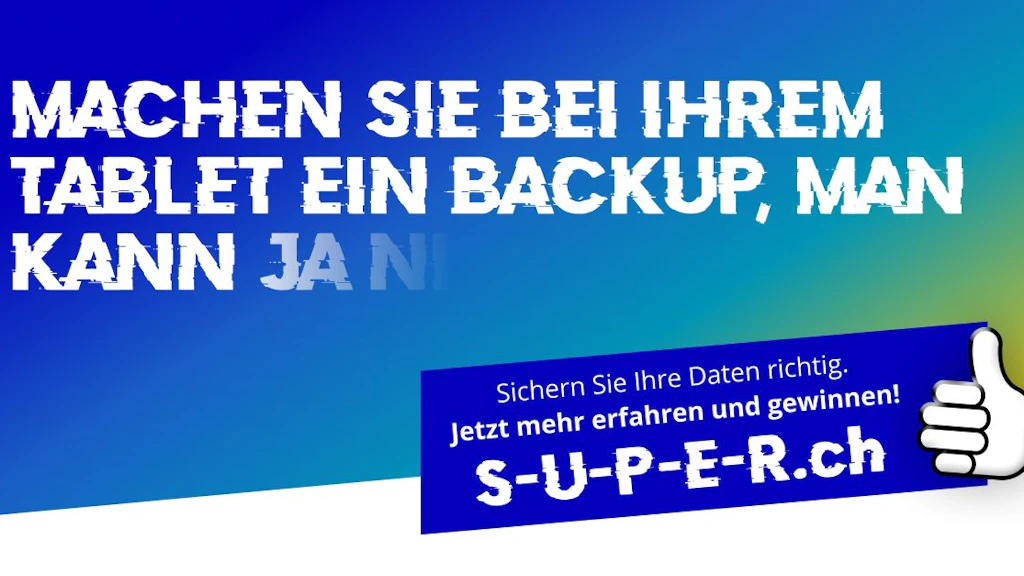
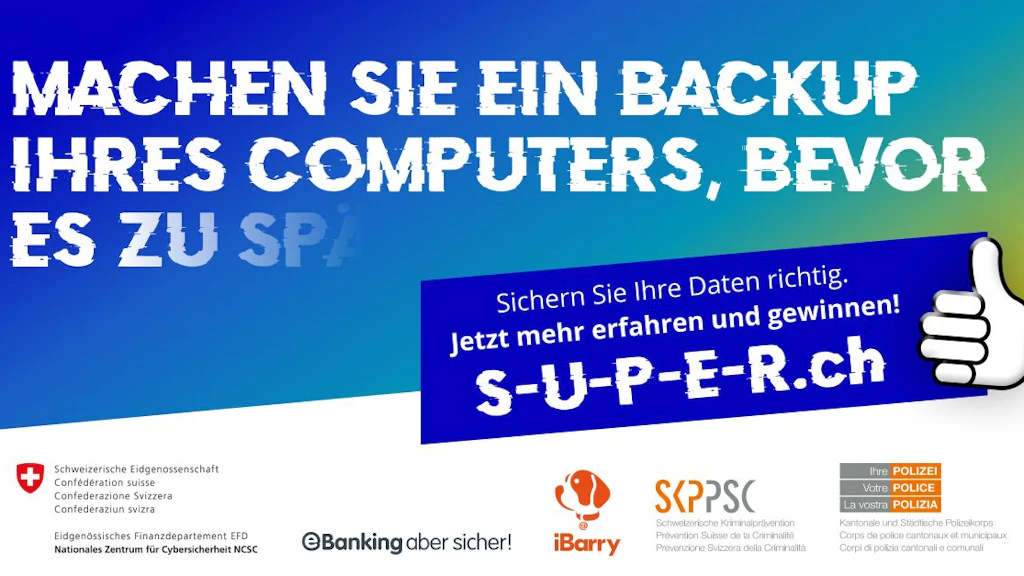
Regularly backing up data is very important and makes a significant contribution to cybersecurity. If you can rely on a backup of your data, you have a safety net should it be encrypted and blackmailed by cybercriminals or if you lose your device. In September, the NCSC, Swiss Crime Prevention (SCP) and the cantonal and city police forces have launched a national awareness campaign on the importance of backing up data. The campaign was supported by the internet security platform iBarry and “eBanking – but secure!” (EBAS).
s-u-p-e-r.ch
S-U-P-E-R.ch – How to properly delete data that is no longer needed
18.09.2023 - Backing up data is not the only important thing. If information is no longer required, it should be properly deleted or destroyed. However, «deleting» is not the same as «permanently deleting». Deleting data is generally a multi-stage process, as electronic data is not completely removed when it is deleted with the delete key or the delete function. To delete data permanently, the storage location of the information must be repeatedly overwritten.
S-U-P-E-R.ch – What to bear in mind when backing up data
07.09.2023 - Much of the data that is important to us, such as photos, appointments or contacts, is now stored on our smartphones, tablets or computers. But what happens if your smartphone is lost, your computer is attacked or your tablet develops a technical defect? All of the data is lost in a split second. Unless you have a backup. At times like these, it becomes all too clear just how important it is to back up your data regularly.
Security authorities launch national awareness campaign on backing up data
31.08.2023 - Regularly backing up data is very important and makes a significant contribution to cybersecurity. If you can rely on a backup of your data, you have a safety net should it be encrypted and blackmailed by cybercriminals or if you lose your device. In September, the NCSC, Swiss Crime Prevention (SCP) and the cantonal and city police forces will launch a national awareness campaign on the importance of backing up data. The campaign is supported by the internet security platform iBarry and "eBanking – but secure!" (EBAS).

Campaign S-U-P-E-R.ch 2023 - Password security
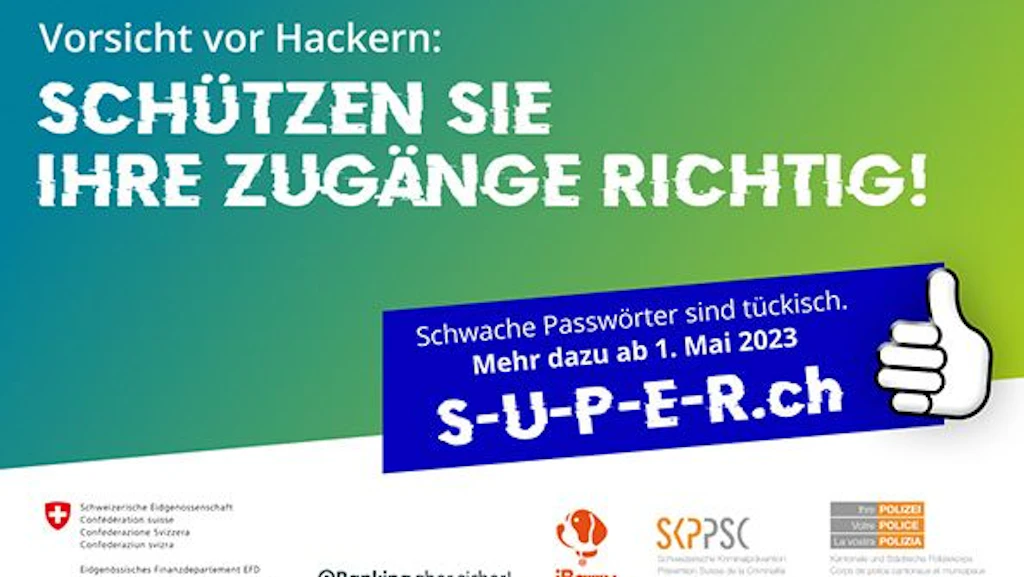
Stolen user data is often at the origin of a cyberattack. Strong passwords can prevent considerable damage. The NCSC, Swiss Crime Prevention (SCP) and the cantonal and city police forces, with the support of the internet security platform iBarry and “eBanking – but secure!” (EBAS), have conducted a national awareness campaign on password security in May.
s-u-p-e-r.ch
S-U-P-E-R.ch – Double up on securing your access
25.05.2023 - 2-factor or multi-factor authentication (2FA or MFA) is a security mechanism that requires users to provide two or more forms of identification in order to access a system or application.
S-U-P-E-R.ch - Be sure to manage your passwords securely
15.05.2023 - The issue of password security can be a nuisance, as you have to create complex passwords and remember them. In addition, you are supposed to use a different password for every online account and can lose track of them.
S-U-P-E-R.ch - Create secure passwords
04.05.2023 - Strong passwords are important, as they protect against unauthorised access to personal and sensitive data. Weak passwords can easily be guessed or hacked, thereby posing the risk of identity theft, fraud and other types of cybercrime.
Launch of the national cybersecurity awareness campaign
01.05.2023 - Stolen user data is often at the origin of a cyberattack. Strong passwords can prevent considerable damage. The National Cybersecurity Centre (NCSC), Swiss Crime Prevention (SCP) and the cantonal and city police forces, with the support of the internet security platform iBarry and "eBanking – but secure!" (EBAS), will be conducting a national awareness campaign on password security in May.

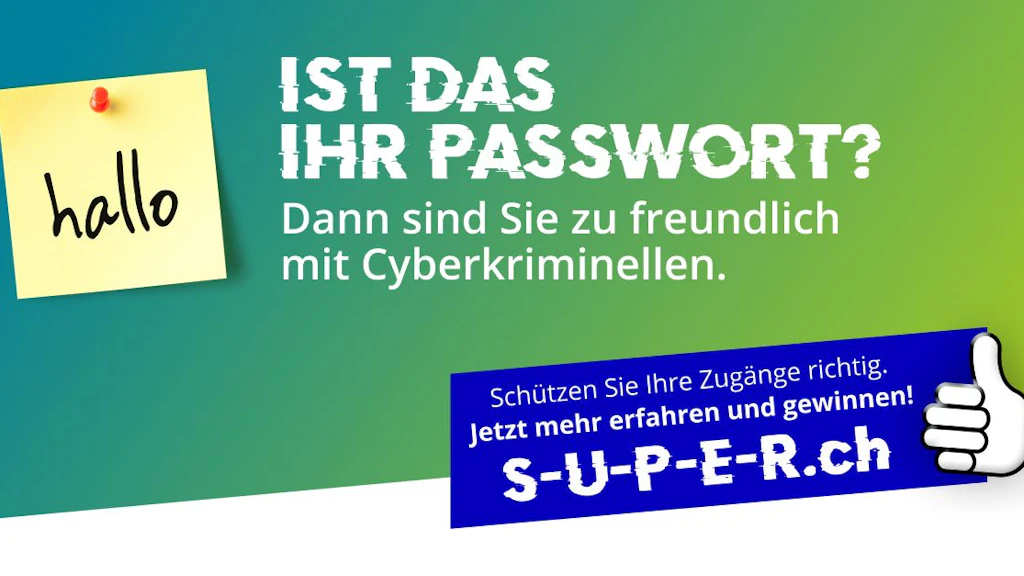
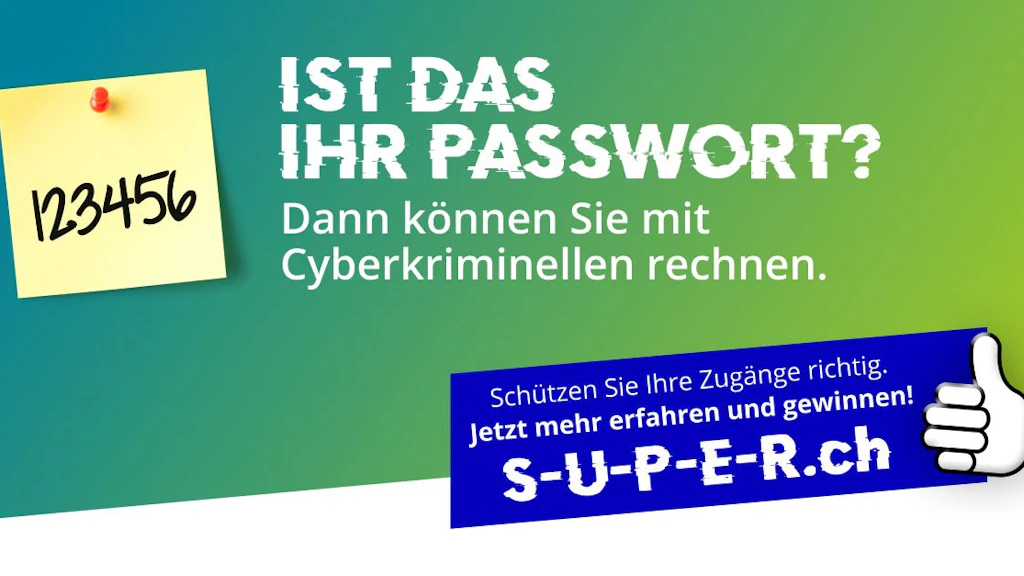
Campaign S-U-P-E-R.ch 2022
Cyberattacks via email and messenger services are on the rise. They can be detected by critically examining messages, thereby making it possible to avoid major financial losses and personal suffering. To promote public awareness, the NCSC and Swiss Crime Prevention SCP, together with the cantonal and city police forces, ran the S-U-P-E-R.ch national cybersecurity awareness campaign from 5 September to 16 October 2022.
s-u-p-e-r.ch
S-U-P-E-R.ch - Malware
03.10.2022 - Be wary of an email urging you to open an attachment. It could be a fraudulent message used by criminals to try to install malware on your computer.
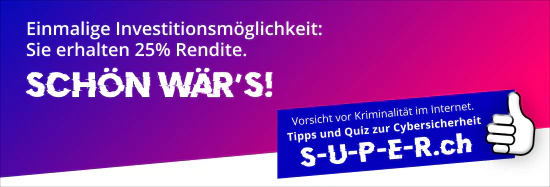
S-U-P-E-R.ch – Investment Fraud
26.09.2022 - Invest in cryptocurrencies and make a lot of money quickly with little effort. Wouldn't it be nice! Criminals try to get their hands on your money with offers of fake or bad investment opportunities. Not only will you not make any money, but you will also lose the money you invest.
S-U-P-E-R.ch - Fake-Sextortion
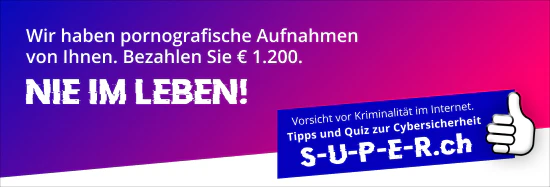
19.09.2022 - «We have pornographic images of you and will publish them unless you pay EUR 1,200.» Do not comply with such requests under any circumstances, as this is a nasty scam called fake sextortion. The blackmailers send such messages on the off-chance of reaching recipients who have visited pornographic websites. In most cases, the recipients are also put under pressure to pay the ransom quickly.
S-U-P-E-R.ch - Phishing
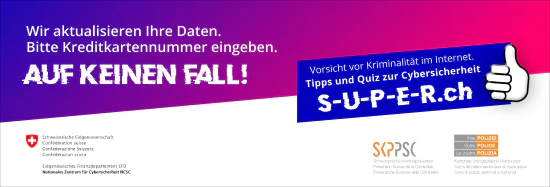
12.09.2022 - «Your financial institution» notifies you that your account is blocked and that you should update your credit card details using the link in the message. Or that you supposedly paid an invoice twice and are now entitled to a refund. All you have to do is click on the link in the message. Do not do this under any circumstances!
S-U-P-E-R.ch - Fake fees
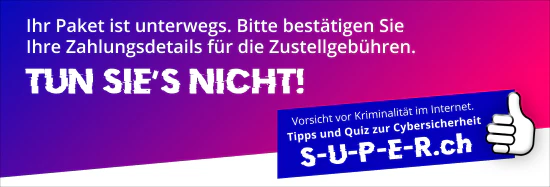
08.09.2022 - «Your parcel is on its way and will be delivered to you as soon as possible. However, we are still awaiting your payment». This is what your alleged parcel delivery service or the customs authority purportedly tells you by email or text message. You are supposed to confirm your delivery by clicking on the link. Don't!
Launch of the national cybersecurity awareness campaign
05.09.2022 - Cyberattacks via email and messenger services are on the rise. They can be detected by critically examining messages, thereby making it possible to avoid major financial losses and personal suffering. To promote public awareness, the NCSC and Swiss Crime Prevention SCP, together with the cantonal and city police forces, are launching the S-U-P-E-R.ch national cybersecurity awareness campaign on 5 September 2022.


Campaign S-U-P-E-R.ch 2021
In close collaboration with Swiss Crime Prevention (SCP), the Lucerne University of Applied Sciences and Arts and the Swiss Internet Security Alliance SISA, it ran SUPER, a national awareness campaign; over a five-day period, awareness was raised among the general public about the safe use of computers and smartphones.
s-u-p-e-r.ch
Be vigilant
07.05.2021 - Your personal conduct in the digital world is important. Therefore: Reduce the risk of fraud by staying alert, always use your common sense and share as little personal information as possible.
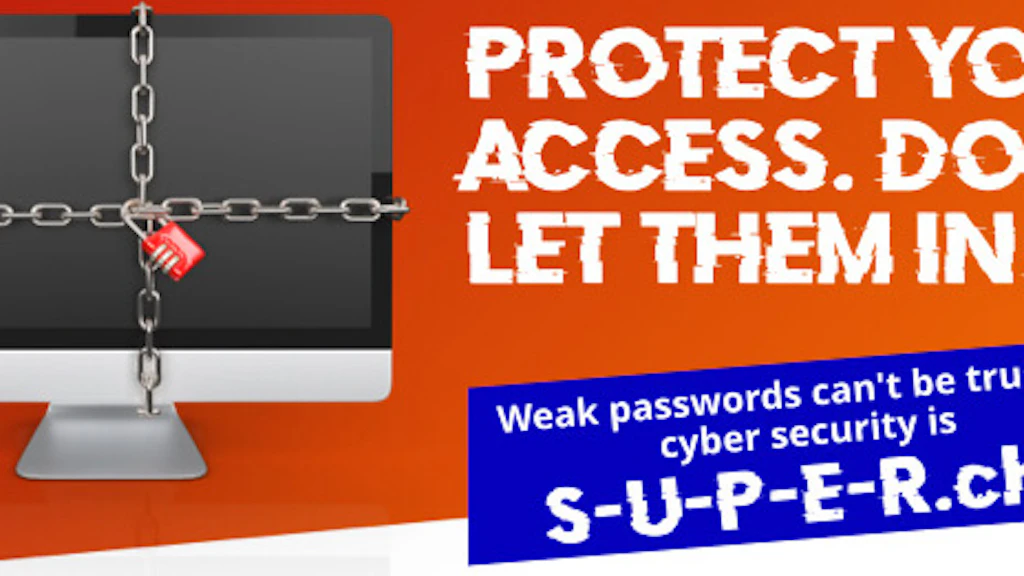
Use strong passwords
06.05.2021 - Your personal data on your computer, smartphone or tablet is valuable. But also remember your credit card data stored on online shops or your e-banking login credentials. It is therefore all the more important that your accounts are protected. Be sure to use strong passwords.
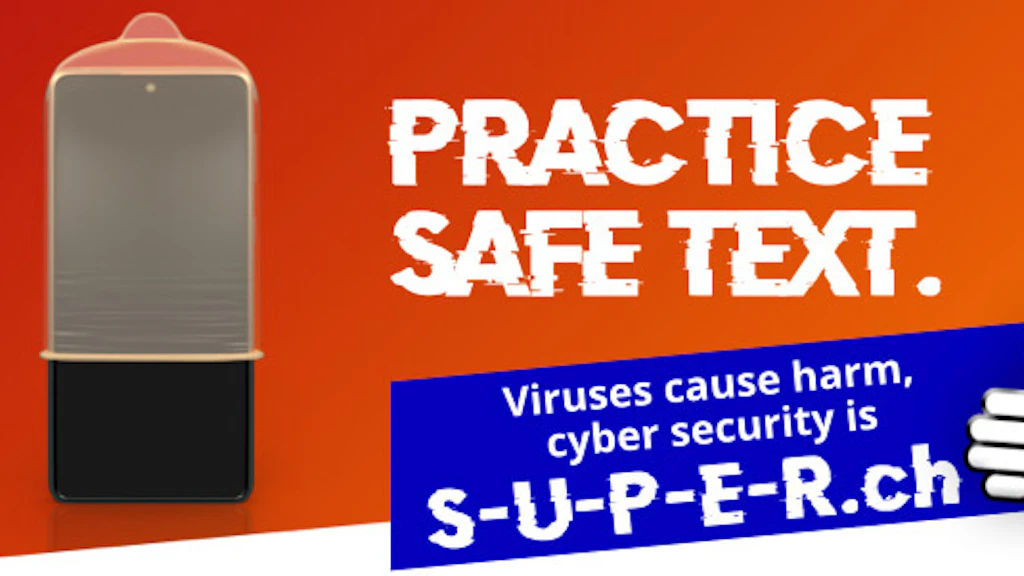
Ensure you have anti-virus software
05.05.2021 - If no specific measures are taken, a computer, tablet or smartphone is defenceless against the dangers of the internet. Malware (viruses, worms, Trojans, etc.) can be used by unauthorised parties to view, alter or even delete your data. Therefore: Check your device to see if antivirus software is installed and a firewall is activated.
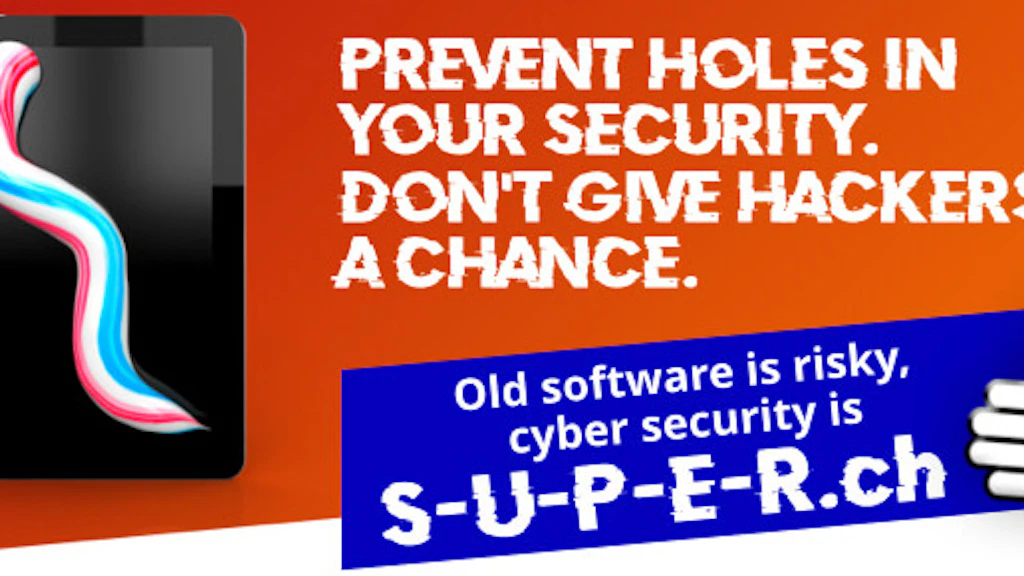
Updates: Close dangerous security vulnerabilities
04.05.2021 - Out-of-date software often harbours security risks. It makes it easier for attackers to take control of a device. Software manufacturers regularly update their software and make the changes available as updates. Therefore: Update your system, programs and apps regularly with the latest versions.
Back up your data regularly!
03.05.2021 - Documents, emails, photos, videos, music and much more are stored as digital data on computers, smartphones and tablets. But it cannot be ruled out that they will be lost, e.g. through accidental deletion, technical defects, theft of a device or a virus. Therefore: Back up your data regularly!

Webinars
The following webinars were held as part of the SUPER campaign:
How is a password cracked?
Make it difficult for criminals to access your data. In this webinar, we will show you why strong passwords are so important and the key points to consider.
Experts:
Oliver Hirschi, Lucerne University of Applied Sciences and Arts Lecturer, Head of “eBanking – but secure!”
Host:
Katja Dörlemann, Security Awareness Specialist, SWITCH
Language:
German
Voice phishing – a case study
How do prosecution authorities deal with the challenges of fighting cybercrime? We demonstrate with a practical example.
Expert:
Sandra Schweingruber, Federal Attorney, Cybercrime Specialist, Office of the Attorney General of Switzerland
Host:
Dominique Trachsel, Head of Awareness-Raising and Prevention, NCSC
Language:
German
How does malware work?
Malware is insidious. It infects computers and often carries out unwanted and harmful actions unnoticed. Find out what you can do if your computer is infected.
Expert:
Sophie Nägeli, Cybersecurity Project Manager, NCSC
Host:
Mauro Vignati, Head of Vulnerability Management, NCSC
Language:
Italian